Art and Culture Class 01
INTRODUCTION TO THE SUBJECT (5:04 P.M.)
- Culture is the way of life.
- The understanding of culture helps the administrators in devising the policies that are acceptable to the society.
- The absence of such understanding may lead to insensitive behavior as shown by the United States help campaign during the Bhuj earthquake campaign.
- Culture is dynamic. The cultures that don't change may become extinct.
- The Indian economy cannot work without its culture. We are a culturally driven economy.
- Topics
- (a) Architecture and Sculpture
- (b) Religion and Philosophy
- (c) Classical Dance
- (d) Classical Music
- (e) Indian Paintings
- (f) Language and Literature
- (g) Bhakti and Sufi Movement
REFERENCE MATERIAL
- Introduction to Fine Art, Part I and II. (NCERT)
- Class Notes.
- VisionIAS material.
ANCIENT ARCHITECTURE (5:30 P.M.)
- Indus Valley Civilization (2600-1800 BCE)
- Mauryan Age Art (321- 185 BCE)
- Post-Mauryan Art (185 BCE- 200 AD)
- Gupta Age Art (319 AD- 550 AD)
- South Indian Architecture (600 AD-1100 AD)
MEDIEVAL ARCHITECTURE (INDO-ISLAMIC ARCHITECTURE)
- (a) Delhi Sultanate (1206-1526 CE)
- Imperial Art
- Slave Period (1206- 1290)
- Khilji Period (1290-1320)
- Tuglaq Dynasty (1320-1414)
- Sayyid (1414-1451)
- Lodi (1451-1526)
- Provincial Art (1200-1600)
- Bengal Art
- Jaunpur Art
- Malwa Art
- Bijapur Art
- (b) Mughal Period (1526-1707 CE)
- Mughal Art
- Akbar (1556-1605)
- Jehangir (1605-1627)
- Shah Jahan (1627-1658)
- Aurangzeb (1658-1707)
- Provincial Art
- Rajput Architecture
- Sikh Architecture
MODERN BRITISH PERIOD ARCHITECTURE (1765-1947)
- Indo-Gothic Style of Architecture (1765-1911)
- Neo-Roman Style of Architecture
- Awadh Architecture (Contemporary to British Architecture)
INDUS VALLEY CIVILIZATION (5:50 P.M.)
- Topics to be covered
- (a) Seals
- (b) Pottery
- (c) Sculptures
- (d) Town Planning
- In 1921, Dayaram Sahni excavated the site of Harappa in the Montgomery district of Pakistan.
- Later in 1922, Rakhal Das Banerjee excavated the town of Mohenjodaro in the Sindh province of Pakistan.
- With the excavation of the two sites, it was proven without a doubt that the Indus Valley was one of the most advanced civilizations in the world.
- The most advanced feature of this civilization was the use of burnt brick of the same shape and size.
- Another advanced feature was the immaculate urban planning of the Indus Valley towns.
- Following are the important artefacts and architectural details of the Indus Valley:
- Seals
- Seals are one of the most important sources of information about the Indus Valley Civilization.
- To this date, more than six thousand seals have been found.
- Seals are geometrically shaped objects mainly made up of soft river stone Steatite.
- But there are instances of seals made from copper, bronze, terracotta, gold, and silver as well.
- Seals were pictographic.
- This means it had a good number of pictures and symbols.
- These symbols were created from right to left direction.
- Examples,
- (a) Pashupati Seal
-
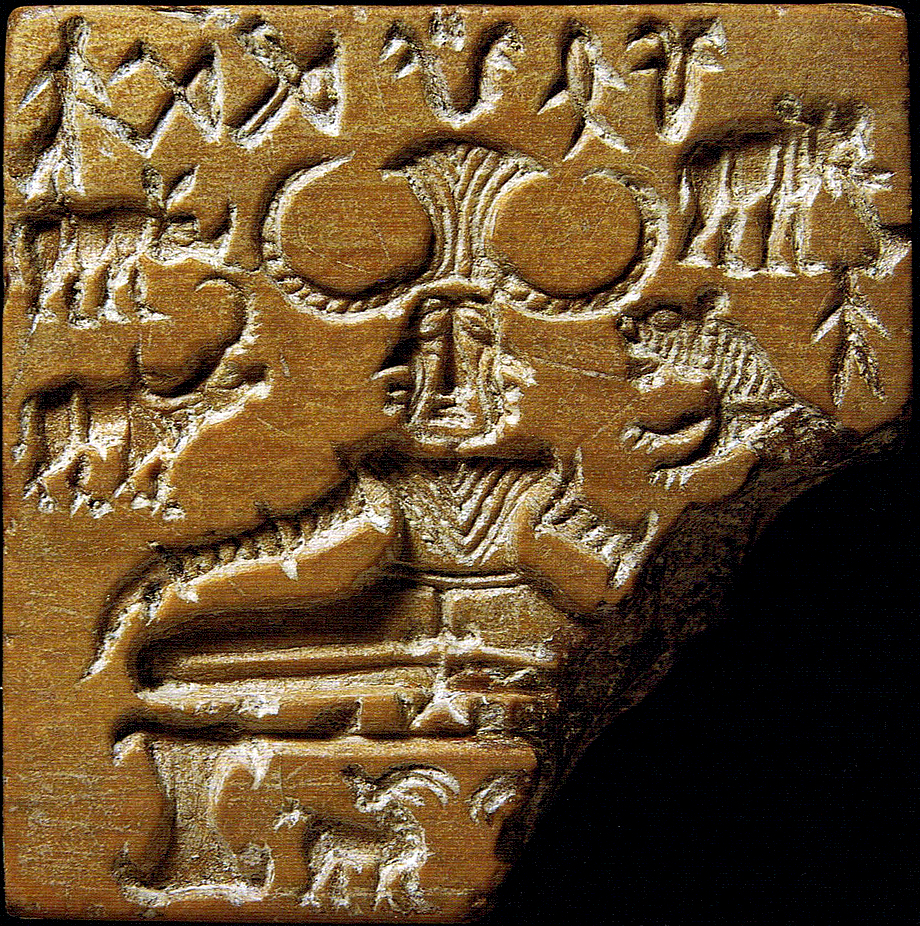
- Majority of the historians refer to it as the image of proto-shiva or Adi-shiva.
- The seal depicts the concept of cohabitation and nature worship, and it seems that yogic practices were known to the Indus Valley People.
- (b) Seal with the peepal leaf
-
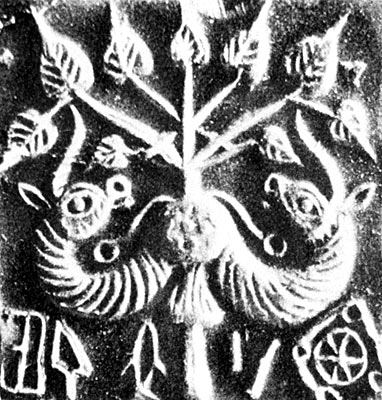
- This seal indicates nature worship.
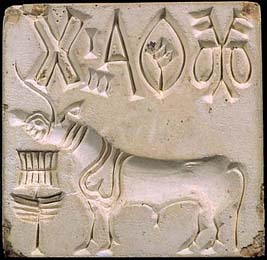
- (c) The most abundant seal found in Indus towns was the unicorn seal.
- It is the depiction of a one-horned mythical animal.
-
- Purpose of the Seal (6:21 P.M.)
- (a) Perhaps, the seals were the earliest type of coinage, which facilitated in-trade.
- (b) They are also believed to be stamps of the Indus Valley Civilization.
- (c) In some of the seals mathematical symbols like pi and phi were also created, which suggests that maybe they were also used as an educational tool.
- (d) Seals were also used as shamanic amulets to ward off the evil spirit.
- Pottery (6:28 P.M.)
- (a) General Purpose Pottery
- The general-purpose pottery of the Indus Valley Civilization was red or ochre.
- It was mainly used as utensils, storage of grains and water, etc.
- (b) Miniature Vessel
- They were small, narrow, but elongated pottery with beautiful designs on it.
- It was mainly used for decoration.
- (c) Perforated Pottery
- These potteries had wider mouths, and the body had innumerous perforations.
- Generally, it was smokey grey and was meant for straining liquor.
- (d) Faience Pottery
- Faience was a bony white material mainly found in the upper part of Gujarat.
- It was used for creating small utensils with beautiful designs.
-

- Sculpture (6:41 P.M.)
- Sculpture is a three-dimensional piece of art purely based on one's imagination.
- There were three types of sculptures discovered from the Indus towns.
- (a) Stone Sculpture
-
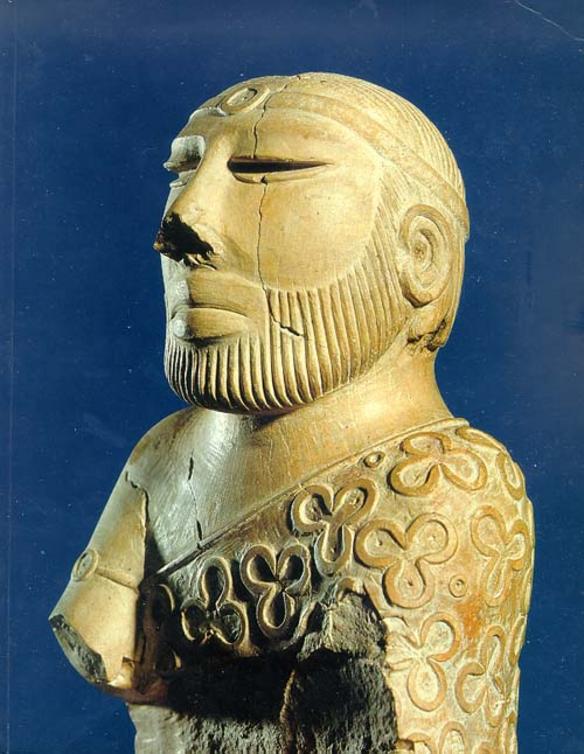
- There are very examples of stone sculptures. They were made from soft riverstone steatite.
- The best surviving example is the image of a bearded priest draped with a trefoil-patterned shawl and wearing a headband and an armband.
- (b) Terracotta Sculptures (7:06 P.M.)
- Terracotta means the clay shape which is baked on fire.
- A large number of terracotta figures were created in the Indus towns.
- The most abundant terracotta figure found in almost all the Indus towns is the image of the mother goddess.
- She is also regarded as the goddess of fertility.
- Based on the abundance of this image, the majority of historians believe that the Indus society was matriarchial in nature.
-

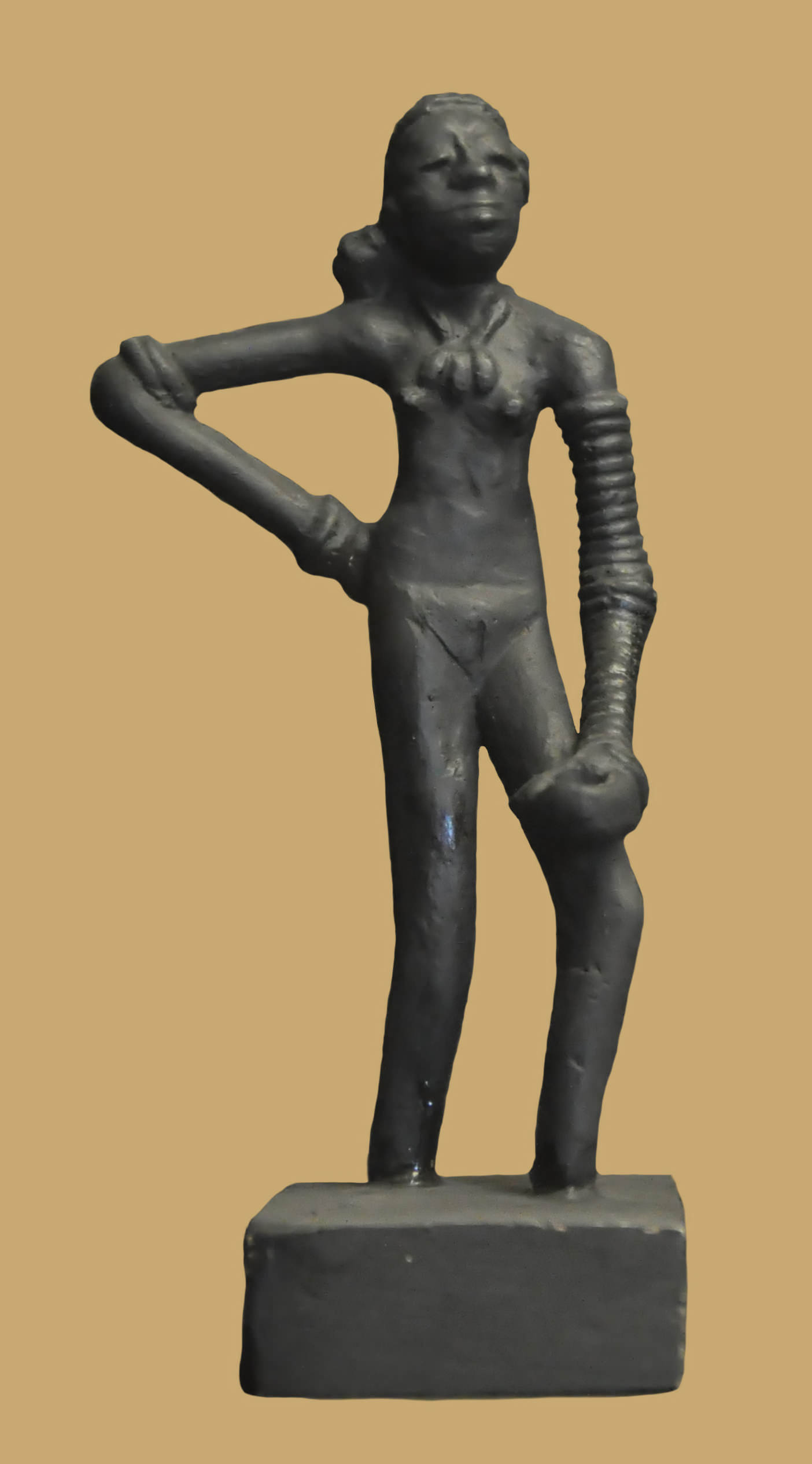
- (c) Bronze Sculpture
- The bronze sculpture was created through the lost wax technique.
- In the very first step, a wax sculpture was created to be covered with clay.
- Now, the figure was baked in fire, and molten wax was replaced with molten bronze.
- After enough cooling hardened clay was removed and the sculpture was polished and refined.
- For example, the Dancing Girl of Mohenjodaro.
-
URBAN PLANNING AND TOWN PLANNING OF INDUS VALLEY CIVILIZATIONS (7:26 P.M.)
- Generally, Indus towns were divided into two parts, i.e. upper town and the lower town.
- Upper town was created on an upraised platform and generally, they were fortified.
- In this part of town, mainly administrative buildings were created.
- Apart from that, granaries were created for the storage of grains.
- These were created scientifically so that they would not get spoiled due to anaerobic fermentation.
- Another remarkable feature of the upper town was the provision of the common bath.
- The best example is the great bath of Mohenjodaro.
- Great Bath
- It is a stepped water tank.
- The stairs are created in the north and south directions.
- Moreover, the stairs were made from burnt bricks of the same shape and size.
- On the east and west sides, the galleries, changing rooms, and washrooms were created.
- Lower Part of the Town
- The lower town was mainly meant for habitation of the commoners and it was the largest part of the town.
- It had a very good network of roads, which used to cut each other at right angles.
- On both the sides of road, the drains were covered with either stone slab or brick slab.
- These drains had cesspits coated with gypsum at regular intervals.
- Gypsum filtered the wastewater and recharged the ground with clean water.
- Towns were divided into many sectors inside which the houses were created with burnt bricks of the same shape and size in the ratio of 4:2:1.
- Generally, the houses were not created facing the direction of the main road.
- Perhaps it was done to keep their privacy intact.
- Inside the sectors, we come across examples of single-storied houses, double-storey, and even triple-storey houses.
- Though the inequality can be seen, the society was not discriminatory.
- Each of the houses had a separate bedroom, kitchen, and washroom.
- The houses were connected to the main drain.
- The town of Dholavira is an exception to the two-layered planning. In this part, the town was divided into three parts, i.e. upper town, the middle town, and the lower town.
- Another notable feature of the Dholavira is the radial drainage system.
- Recently, the site of Dholavira was included in the UNESCO Heritage Sites.
THE TOPIC FOR THE NEXT CLASS: ARCHITECTURE AND SCULPTURE (CONTINUED)